

The Development and Contribution of Monasticism in Christianity
Why did this seemingly peculiar movement arise and how is it significant?

Something about the fall always makes me want to read more, and I was not particularly inclined to write a new post for this week. As I still remain committed to posting every Wednesday, here is a paper I wrote for my church history class in Bible college about the contribution of monasticism in Christianity, mainly in the Middle Ages. I apologize for the fact that it is somewhat dry but perhaps someone will find it interesting anyway. Additionally, I think I used a few too many quotes.
Over the centuries, many things have affected the way the church is today. While some may dismiss monasticism as an obscure practice of the distant past, it has had a significant impact on the church’s history. Failure to recognize this leads to an incomplete understanding of Christianity’s past. Most people of the 21st century find it puzzling why anyone would give up the comforts of a normal life and be an ascetic. There are numerous debates surrounding this topic, such as the overall impact of monasticism on the church, but none can deny its influence on several of the most prominent Christians. Although largely forgotten in many denominations today, monasticism had a great impact on the church by preserving vital Christian writings, promoting literacy, and training some of the most influential Christians of the Middle Ages.
One of the most defining moments in early church history was when Emperor Constantine made the Edict of Milan, which allowed Christianity legal protection under the Roman government. At first, this might seem like an exclusively positive change from the seasons of persecution under many earlier emperors, but it soon sowed discontent among several Christians. When the persecution of the church ceased, frustration emerged among faithful Christians due to the dramatic drop in the risk of being a Christian.1 Suddenly, the courage of a martyr was no longer required, meaning that many adopted Christianity, not based on strong convictions of truth, but due to the increasing Christian influence on the empire. Monasticism then developed out of the conversion of the Roman Empire to Christianity as a replacement for martyrdom.2 These first monks retreated to the desert with a motivation to give up their lives for the gospel. Becoming a monk was viewed as a way of sacrificing individual freedom to pursue a deeper relationship with God, comparable to the early Christian martyrs.3
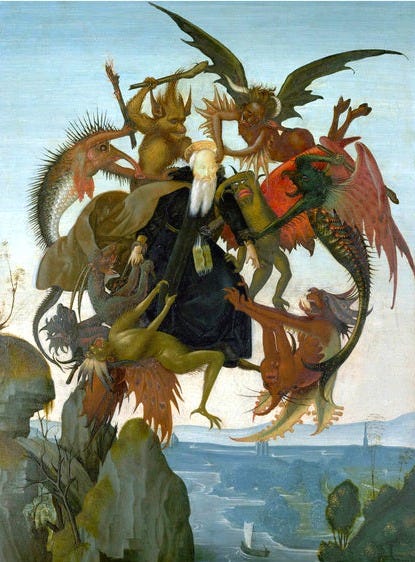
A man named Anthony was one of the first monks who, prompted by the words of Jesus to the rich man, sold all he owned to live a life of solitude in the desert.4 Anthony was the oldest of three, born in 251 to a Christian family in central Egypt.5 Raised in a wealthy Egyptian household and inspired by Matthew 19:21, Anthony gave up all his possessions and moved to the desert around 270-275 CE.6 After fifteen years of learning from ascetic teachers, he began living in a tomb, then moving further into the desert and eventually dying at age 105.7 Others were motivated by his example and formed colonies of hermits to live a life of asceticism and prayer. Athanasius, the main opponent to Arius, wrote his biography, The Life of Anthony. This was a work that greatly contributed to the spread of monasticism.8 The Life of Anthony describes common monastic values such as prayer, asceticism, fighting evil spiritual forces, and helping the poor.9 More than any other early Christian text, the Life of Anthony establishes the categories for thinking about institutionalized eremitical monastic life.10
The first type of monasticism was hermit life, consisting of monks living in an isolated place.11 Everett Ferguson describes this well. “By the end of the third century the ascetic impulse began to express itself in a greater degree of withdrawal from society, at first near cities and villages, but soon by flight to greater solitude in the uninhabited or sparsely inhabited regions near the Nile valley.”12 As Gert Melville wrote, “Liberated from worldly affairs, from the concerns of the church and their obligations to the overseers of their communities, the bishops, they retreated to caves, huts, or ruins in the desert, where they lived lives of contemplation, of penitence and bodily chastisement, of sexual continence and manual labor.”13 The ascetic movement became quite powerful, causing many to move to the desert or make significant changes in their lives.14 One extreme example is that of Symeon Stylites, who lived on top of a pillar, practicing fasting and standing for long periods.15 Monasticism, however, has not been without critics. The two main objections to hermit life are that it is not biblical and that the antisocial nature of this lifestyle caused the decline of civilizations.16
A well-known written document containing numerous phrases of the early monks and nuns is the Sayings of the Desert Fathers.17 This text helped promote eremitical life. An important practice of the monks was their use of the codex for copying scripture, first with papyrus and then parchment, which was of finer quality.18 There were some common themes in early monastic literature. First, they made frequent use of military imagery, specifically in terms of demonic and angelic spiritual forces.19 C. H. Lawrence commented, “The spiritual life of the monk was a ceaseless warfare against demons, who roved the world seeking to exploit the weaknesses of man’s fallen nature. The anchorite needed to be well equipped for his lonely confrontation with the rulers of the world’s darkness.”20 Monastic writings also emphasized that they viewed themselves as the successors of the martyrs.21
Furthermore, anger was frequently condemned in early monastic writings. Greg Peters provides valuable insights on this. “For the desert fathers anger was an issue of self-mastery; the monk who was angry gave evidence of his lack of self-control, which manifested itself in either verbal slights or pejorative physical actions… Anger was a sin to be avoided if one wanted to be a true monk.”22 It was during the early third century that Christianity became influential in Egypt.23 A proposed explanation for the origins of monasticism in Egypt is that prevalent Gnostic beliefs caused it, as asceticism was a key component of both belief systems24. Such a correlation, however, has its drawbacks as some evidence suggests that early Christianity existed separately alongside Gnosticism, not mixed.25 Furthermore, there is a connection between monasticism and pagan philosophers. Both groups practiced asceticism, valued knowledge highly, and found freedom from regular life.26
Monks began living together in Christian monasteries in about 320, bringing a shift in the monastic movement.27 Pachomius, a fourth-century Egyptian convert from the town of Latopolis28 was the one who came up with this idea after realizing that many Christian values were impossible without relationships.29 After living as a hermit, he founded a monastery in the upper Egyptian village of Tabennesis. A women’s community was started by his sister Mary.30 Pachomius wrote the oldest surviving rule for cenobitic monasticism, describing a community lifestyle focused on poverty, contemplation, and chastity.31
Daily routines were organized to a strict schedule and the residents of such communities worked hard to practice charity.32 Life in a monastery consisted of manual labour, eating, sleeping, worship, poverty, and a uniform.33 Pachomius’s rule also described the process that was expected of those wanting to join a monastery. This included several days of waiting outside while learning the Psalms.34 Pachomian monasteries placed great emphasis on the recital of Scripture, even doing so while working.35 The monastery was encircled by a wall and divided into several houses which each contained twenty monks.36 Many local residents joined monasteries to obtain an education and have more stability than living as farmers.37
After Pachomias, there were many other important figures in the development of cenobitic monasticism. Basil of Caesarea, one of the Cappadocian fathers, wrote the Asceticon, which is a list of rules for monasteries.38 In it, he advocated for communal love as the basis of monasticism.39 Carolinne White said this about Basil’s Rule; “The main characteristics of the way of life Basil recommends are humility, obedience, and striving for restraint with regard to such things as food, money, sex and anger. Basil also provides practical advice with regard to suitable clothing and food and the punishment of bad behaviour, together with guidelines for communal prayer which should be taken seven times during the day in addition to one service at night.”40 He concluded that the cenobitic life was better than complete isolation, as it made it possible to fulfill Jesus’ command to love your neighbour.41
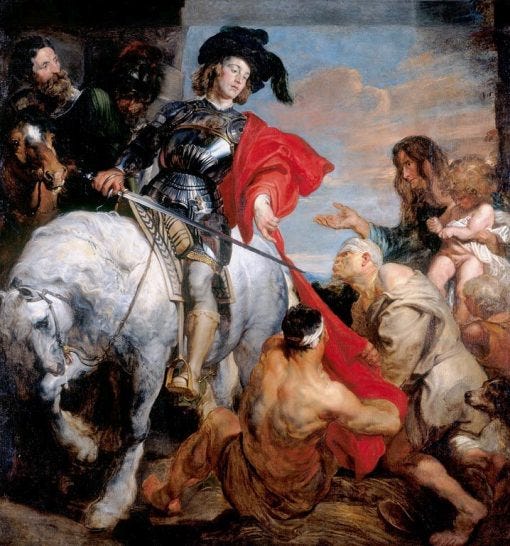
Also, Martin of Tours in the fourth century was a soldier who, upon meeting a beggar, divided his cloak and gave part of it away.42 This inspired him to get baptized and give up fighting.43 He then founded monastic groups in the forested regions of Europe which were not very structured.44 Jerome wrote extensively on the benefits of asceticism.45 Honoratus of Arles between 405 and 410, started a monastery at Lérins that used a very stable form of organization.46 This type of monasticism spread north and was popular with the nobility.47 The Rule of Augustine “describes the reason for becoming a monastic (love of God and neighbor), how to live in community, and how to be moderate in ascetical activity.”48 An anonymous text that also was used in the formulation of future monastic writings is the Rule of the Master, providing much detail on the regulations for monastic life.49 Many monasteries emerged in Ireland after the missionary work of Patrick and had a profound impact on the island’s culture.50 Irish monks practiced voluntary exile as a way to bring the gospel to unreached people.51
Probably the most influential texts in the development of the renowned Benedictine Rule were John Cassian’s Institutes and Conferences.52 John Cassian was a monk from Bethlehem who travelled to numerous monasteries in Egypt to learn monastic theology.53 In the early fifth century, he went to the city of Massalia and founded a community for women and another for men.54 He then moved to Gaul and founded two more monasteries.55 Some of Cassian’s other works were guidelines for monks such as On the Fundamentals of the Coenobitic Life and Conversations with the Fathers which were both very influential.56 These writings taught that, as Melville said, “It was possible to find one’s innermost life (and there alone to find God) by turning away from the institutional church and the earthly entanglements of the world.”57
John Cassian also promoted responsive readings of the Psalms and praying of the hours.58 White commented that Cassian believed, “The aim of the monk, as is made very clear in Book 1 [of the Conferences], is to attain purity of heart and perfect love that will allow him to reach the kingdom of heaven and eternal life: all the elements of the monastic life - prayer, meditation on Scripture, silence, manual labour, restriction of the amount of food and sleep - are the practical means of bringing about that purity of heart which may enable the monk, already in this life, to have a foretaste of the blessedness of the next.”59 Peters wrote, “By developing a system of monastic theology, Cassian bequeaths the spirituality of Anthony, the desert fathers and mothers, and Pachomius to future generations, perennially connecting all of monastic history to the great flourishing of monasticism in the fourth-century deserts of Egypt.”60
The most influential figure promoting monasticism in the West was Benedict.61 Benedict’s life was recorded in the Dialogues of Gregory the Great from the late sixth century.62 Here, the reader learns of Benedict’s abandonment of his studies in Rome to pursue an eremitical lifestyle.63 Benedict was the abbot of a monastery in Nursia, Italy who had lived in a cave before founding the monastery.64 Word of Benedict spread, and he was asked to be the abbot of a monastery, to which he reluctantly agreed.65 He left after an attempted poisoning and founded many monasteries of the Benedictine order with a rule for monks to follow.66 Benedictine monasteries became increasingly popular in Western Europe throughout the Middle Ages.67 In terms of monastic structure, the abbot, who was in charge of the monastery, was elected by the monks. The person in charge of a group of ten monks was called a dean.68 Touching on the significant impact of Benedictine monasticism, Ferguson wrote, “The Benedictine Rule came to supplant all other rules so that Western Monasticism in the eighth to twelfth centuries was Benedictine. Benedictine monasteries became a symbol of stability in a world of flux. They were important in the transmission of culture and in the conversion of peoples north of the Alps.”69
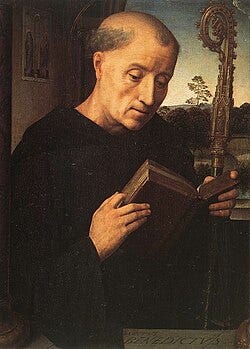
Benedict’s Rule begins by explaining the four kinds of monks. He first mentions the coenobites as “those who live in monasteries and do their service under a rule and an abbot” and the anchorites, or hermits, who go “to the single combat of the desert” to “fight against physical and mental temptations” with the help of God.70 Next, he describes the latter two types of monks in a less-than-flattering manner. The sarabaites are the “most detestable kind of monks” who “take their own desires and pleasures as their laws, calling their every whim holy and claiming that whatever they do not want to do is unlawful.”71 Last is the gyrovagues who, “in every way worse than the sarabaites”, “spend their whole lives wandering around different regions… indulging in their own desires and caught in the snares of greed.”72
The Rule contains some very positive instructions such as the abbot's teaching must align with that of Scripture,73 the monks should treat others well and give help to the poor,74 and be humble.75 Most of the Rule centres on everyday life in the monastery with guidelines on saying the psalms, punishments for disobedience, meals, work, clothing, and community organization. Monks were not allowed to talk during prayer, reading, or meals; they must learn to read. They also could not wash their whole body except when sick and had to bring back to share any food they might find.76 White commented, “By the end of the Rule we are left with a positive and humane vision, in which mutual respect and love among the monks, sharing all property, care for the weak and hospitality shown to strangers emerge as fundamental to the monastic way of life, alongside worship of God.”77
Another important monastic rule was that of an Irish monk named Columbanus. Melville described his rule by saying, “It envisioned a monastic life lived according to the strict Irish expectations of chastity and obedience, expectations that had as their goal the imitation of the suffering, humiliated Christ. Its communities were expected to live in almost uninterrupted prayer, and with prayer they would open the way, so to speak, for their ascent to heaven.”78 Columbanus lived in an Irish monastery and did mission work in the continent before founding several important monasteries.79 These monasteries were not under the authority of a bishop, a practice that was different from the norm.80 Thus, Columbanian monasticism developed into a successful movement. Peters summarized Columbanian beliefs well. “For Columbanus, one’s physical chastity is less important than one’s spiritual disposition to chastity. One’s immaterial, spiritual state was as important as the actual physical practices of the monk.”81 His rule was quite strict and there were harsh punishments consisting of physical beatings for monks who broke the rules.82
Several very influential monastic orders arose in the eleventh and twelfth centuries, shifting the picture of monasticism away from the Benedictine ideas. Melville’s book describes this, “The eleventh century witnessed the remarkably sudden outbreak of a form of religious life that felt itself drawn beyond the boundaries of traditional Benedictine community and toward the full renunciation of all earthly ties.”83 Such an event was inspired by the works of the Desert Fathers as people renounced all the comforts of society to find spiritual renewal.84 One such model of the eremitical life was started by Romuald in Camaldoli, Italy.85 Romuald experienced the Benedictine life but was unimpressed with the lack of rigour and spent several years visiting monasteries.86 The Camaldoli community placed extreme emphasis on solitude and isolation and even influenced Benedictine communities.87 This community was very strict and many of their ascetic practices such as fasting and perpetual silence mimicked the early hermits.88 Another important monastic order that developed in the eleventh century was the Carthusians, founded by Bruno of Cologne.89 This style of monasticism was also modelled on the example of the early desert fathers.90 These and other new monastic orders caused a massive increase in the prevalence of monasteries and the number of people who joined them during the mid-eleventh to mid-twelfth centuries.91
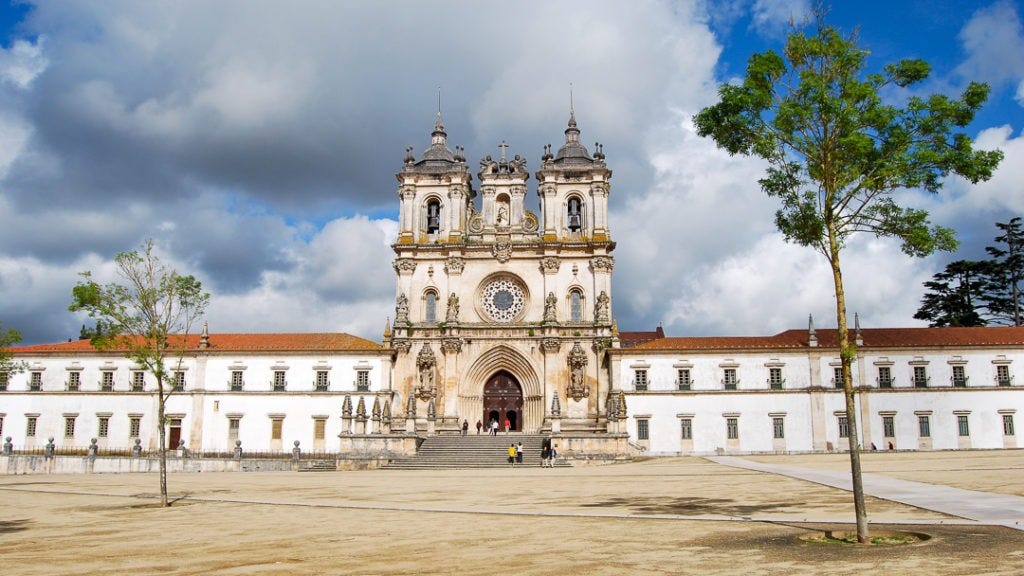
Of all the new monastic movements, the most influential was the Cistercians. The Cistercians were another important group in monasticism that was started in 1098 by a Benedictine monk named Robert of Molesme.92 Founded out of the Benedictine order, they wore white clothing instead of black and became quite popular.93 A second distinguishing characteristic was the lack of adornment in churches.94 It was not uncommon for peasants to join the Cistercians due to the promise of regular food and clothing.95 Another important figure in monasticism was Bernard of Clairvaux, who lived in the early twelfth century.96 He was descended from nobility and served as an abbot for many years.97 The instructions for the monastic life that he wrote is On the Degrees of Humility and Pride, which urges monks to live a life of discipline, asceticism, and contemplation.98 Ferguson’s description of his teachings says, “Bernard’s continuing influence is due to his unique combination of an ascetic and mystical holiness with literary genius. He taught people to deny their inclinations to the creaturely and sensual and cultivate a devotional, penitential, and Christ-centered experience of piety.”99
Throughout its long history, the monastic movement has contributed much to Christianity, such as conserving Scripture and other early Christian writings, maintaining knowledge, and providing a place of study for many prominent Christian thinkers. I believe that it was a necessary development in church history and what started with a few Christians living alone in the desert became a significant institution that preserved the Christian faith over a period of many centuries. Despite being a controversial subject since the Reformation, the influence of monasticism remains. A powerful force in church history, monasticism has done much for us today.
BIBLIOGRAPHY
Binns, John. The T&T Clark History of Monasticism: The Eastern Tradition. New York, NY: Bloomsbury Publishing, 2020.
Burton-Christie, Douglas. The Word in the Desert: Scripture and the Quest for Holiness in Early Christian Monasticism. New York, NY: Oxford University Press, 1993.
Ferguson, Everett. Church History. Vol 1, From Christ to Pre-Reformation: The Rise and Growth of the Church in Its Cultural, Intellectual, and Political Context. Grand Rapids, MI: Zondervan, 2005.
Lawrence, C. H. Medieval Monasticism: Forms of Religious life in Western Europe in the Middle Ages. 4th ed. Medieval World Series. New York, NY: Routledge, 2015.
Melville, Gert. The World of Medieval Monasticism: Its History and Forms of Life. Translated by James D. Mixson. Collegeville, MI: Liturgical Press, 2016.
Peters, Greg. The Story of Monasticism: Retrieving an Ancient Tradition for Contemporary Spirituality. Grand Rapids, MI: Baker Academic, 2015.
Shelley, Bruce L. Church History in Plain Language. 5th ed. Edited by Marshall Shelley. Grand Rapids, MI: Zondervan, 2020.
White, Carolinne, trans. The Rule of Benedict. New York, NY: Penguin Group, 2008.
Shelley, Church History, 167.
Ferguson, Church History, 186.
Shelley, Church History, 170.
Ibid., 167.
Binns, History of Monasticism, 33.
Melville, World of Medieval Monasticism, 20.
Binns, History of Monasticism, 34-35.
Ferguson, Church History, 205.
Peters, The Story of Monasticism, 47-48.
Ibid., 48.
Ferguson, Church History, 228.
Ibid., 227.
Melville, World of Medieval Monasticism, 20.
Burton-Christie, Word in the Desert, 8.
Binns, History of Monasticism, 63-64.
Burton-Christie, Word in the Desert, 11.
Peters, The Story of Monasticism, 48.
Burton-Christie, Word in the Desert, 44.
Ferguson, Church History, 229.
Lawrence, Medieval Monasticism, 23.
Ferguson, Church History, 229.
Peters, The Story of Monasticism, 50.
Burton-Christie, Word in the Desert, 35.
Ibid., 37-38.
Ibid., 38.
Ibid., 54.
Shelley, Church History, 169.
Binns, History of Monasticism, 41.
Shelley, Church History, 169.
Melville, World of Medieval Monasticism, 24.
Ibid.
Ibid., 25.
Ibid.
White, The Rule of Benedict, 17.
Peters, The Story of Monasticism, 53-54.
Binns, History of Monasticism, 44.
Ibid., 45.
Peters, The Story of Monasticism, 62-63.
Ferguson, Church History, 230.
White, The Rule of Benedict, 19-20.
Lawrence, Medieval Monasticism, 8.
Binns, History of Monasticism, 107.
Ibid.
Melville, World of Medieval Monasticism, 29.
Ibid.
Ibid., 30.
Ibid.
Peters, The Story of Monasticism, 67.
Ibid.
Melville, World of Medieval Monasticism, 32.
Ibid., 33.
White, The Rule of Benedict, 21.
Peters, The Story of Monasticism, 55.
Ferguson, Church History, 231.
Peters, The Story of Monasticism, 55-56.
Melville, World of Medieval Monasticism, 31.
Ibid., 32.
Ibid.
White, The Rule of Benedict, 22.
Peters, The Story of Monasticism, 58.
Shelley, Church History, 171.
Peters, The Story of Monasticism, 78.
Ibid.
Melville, World of Medieval Monasticism, 42.
Peters, The Story of Monasticism, 79.
Ibid.
Shelley, Church History, 174.
Ferguson, Church History, 314.
Ibid.
White, The Rule of Benedict, 54.
Ibid., 54-55.
Ibid., 55.
Ibid., 56.
Ibid., 62.
Ibid., 69.
Ibid., 18.
Ibid., 15-16.
Melville, World of Medieval Monasticism, 35.
Peters, The Story of Monasticism, 94.
Melville, World of Medieval Monasticism, 37.
Peters, The Story of Monasticism, 95.
Lawrence, Medieval Monasticism, 40.
Melville, World of Medieval Monasticism, 105.
Ibid., 105-106.
Ibid., 107.
Ibid.
Ibid., 108.
Lawrence, Medieval Monasticism, 138-139.
Ibid., 145.
Peters, The Story of Monasticism, 148.
Ferguson, Church History, 437.
Peters, The Story of Monasticism, 142.
Ferguson, Church History, 439.
Melville, World of Medieval Monasticism, 158.
Lawrence, Medieval Monasticism, 164.
Ferguson, Church History, 440.
Melville, World of Medieval Monasticism, 164.
Ibid., 165.
Ferguson, Church History, 443.
Great Share and very informative actually. I love Athanasius and you really grabbed my attention when you mentioned him.
Thanks Rachel
I also am fascinated by the Fall! What are you reading? Are you working on an article about the Fall?